Showing posts with label art. Show all posts

Apr 22, 2015

Celebrating Earth Day with Go Design Go


Screen Shot 2015-04-21 at 11.12.51 AM
Interior by Mehditash Design
“Having started my career working at Sotheby’s in Portugal, I find myself always attracted to unique antiques and fabulous one of a kind pieces of art that make each design an individualized representation of my clients. By re-using materials and products you are providing them a new home rather than dumping them into landfills. Antiques offer an opportunity to recycle great industrial design while showing gratitude to the artifacts history and story.”—Jennifer Mehditash

Head over to Go Design Go now, to read how these fabulous fellow interior designers make their contribution to being Earth conscious while designing fabulous rooms. 
Collage
From top left corner, clockwise: Jennifer Mehditash, Trudy Dujardin, Sandra Espinet, Campion Platt, Kathleen Walsh

Nov 28, 2014

Peek-a-Boo: Coffee Lovers Jewelry Exhibit in Tel Aviv


Maya Alma Vidan
A bracelet inspired by a cup of coffee and the coffee shop atmosphere. Brass (metalsmithing)


Aren't we all, coffee lovers?

While visiting family in Tel Aviv, I visited an exhibit of stunning new jewelry designed by young Israelis inspired by their love for coffee and coffee houses.

"Metalsmith Cafe" exhibit, curated by Galit Reshef, asked the graduates of the Silversmith Department to allow themselves to feel inspired by sitting in coffee shops, the food, the atmosphere and of course the beloved coffee bean itself. So much a part of the Israeli culture, and almost Parisian like in design and setting, the gathering and morning or evening breaks at the coffee shop are an inherent part of their daily life.

The result? 
Beautifully and skillfully designed bracelets to earrings, necklaces to brooches all intricately hand made by these talented artists and I am thrilled to be able to share them with you on the blog today.


Rings Inspired by Croissants - Smadar Shmueli
Wrapping dough triangles with a touch of soul creates the croissant, and a metal triangle with love and imagination can creare a variety of jewelry. Brass, Silver, Gold Plating (Wax Molding)


Shuli Cohen - Ring Inspired by Paper Cupcake Cups
Oxidized Silver 925 (Wax Molding)


"Tel Aviv’s coffee shops developed with the economic and cultural development of the city. In the second half of the 20th century, following the third and fourth aliyot, a considerable number of coffee shops opened in the then city center – Herzl Street  – designed for the bourgeoisie.  A European influence was obvious in all of them, however they differed a great deal from one another.
From the mid-20th century many coffee shops sprung up along the seashore, following the establishment of exclusive hotels.
These coffee shops were designed for rest and pleasure, and some held cabaret shows and shows by satirical theaters such as Af Al Pi, and Li La Lo. Some of them are still remembered as mythological sites that left a deep mark on the history of Tel Aviv, to mention only a few: Kassit, Vered, Pinati, Noga, Sheleg Levanon,Casino Galei Aviv, Ginati Yam, .."


Moshe Mental
Straight of the sack .. A bracelet made of coffee beans ready to be roasted, accompanied by coffee bean rings.
18K Gold Plated oxidized brass, burlap, fishing wire, leather, garnet
(metalsmithing)


Galit Tzlnik - Bracelets inspried by coffee bars. Gold plated brass, black satin plated brass (Metalsmithing)


The 1930s and the early 1940s saw a “café revolution”.

Numerous cafés sprung up in the new north of Tel Aviv – Allenby, Ben Yehuda and Dizengoff Streets and brought with them a new type of pleasure that was manifested in a well-groomed and stylish appearance, sitting with ones face to the busy street, music and ballroom dance parties, a diverse menu and professional and high-class service.
The café owners took care to maintain an aesthetic façade and enlisted architects and designers to plan the locations. The tables were covered with tablecloths, the plates and cutlery were of superior quality. The menu included appetizing cake, cold and hot drinks and spirits, breakfast, lunch and dinner.
There offered different brands of coffee: Columbia, Brazil and Costa Rica, Turkish coffee, cocoa, milk shakes, cold coffee, “expresso” coffee, or mocha espresso.
Some of the coffee shops had their own character, a result of their habitués. Literary crowds, artists, lawyers, public figures, government and municipality officials, businessmen, journalists, emigrants from Germany, etc. 
In Ginati and Noga, the artist Reuven Rubin, the conductor Michael Taube, Dr. Yosef Pomruk, the writer Menasheh Levin, could regularly be found. From the 1960s California, and Pinati, Stern and Lev Aviv were the coffee shops frequented Bohemian clientelle, offering a kind of second home for writers, poets, painters and artists. 


Rachel Buzaglo
A bracelet and ring inspired by the rising steam from a cup of coffee.
Gold plated brass (metalsmithing)


Keren Merfon
A necklace inspired by a sack of coffee beans.
Gold plated brass, goldfield chain, burlap, embroidery thread

"A Cupcake Brooch" - Maayan Hartmann
Gold plated Brass, carinola, perspex

Idan Yitzchakian
A bracelet and ring inspired by coffee beans.
Beech wood, zircons, gold plated brass (metalsmithing)

"Disposable Spoons" - Racheli Eshel Arnon
Disposable spoons are a necessity in coffee shops. The original spoon is made of a simple material that I have made splendid.
24K gold plated silver, amethyst (wax molding)


Lastly, inspired by the Israeli chain Aroma Cafe, which so happens to be one of my go to places whenever I am in Soho (New York), this set of rings took color and style leads from their logo.

Anat Traum
"Coffee at Aroma"

Collection of nine rings composed of three color groups, matching the coffee chain's logo. The geometry of the rings is inspired by the logo's shape.
Colored Brass, 24K Gold plated silver (Metalsmithing, Wax Molding)


I could own each and every one of these pieces!
Hope you enjoyed my little tour through Tel Aviv, and come back soon for more on my design and travels!


*images: Jennifer Mehditash
*history of coffee shops: Eretz Museum

Nov 26, 2014

Peek-a-Boo: Discovering Oscar Niemeyer while Shopping for Art in Tel Aviv


TACTIC - High end designer clothing store in Kikar Hamemdina

Growing up, I spent many a summer in Tel Aviv visiting my father and family as I traveled with my sister back and forth from California.

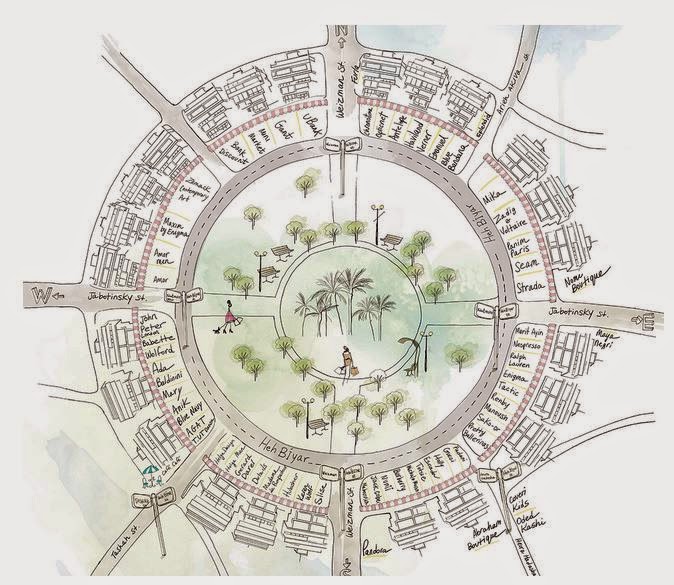
Spending time in the city involved many days on the beach and at the pool of course, but also visiting one of the city's oldest and largest "Retail Roundabout" - Kikar Hamemdina. where I would stand in line to buy my school shoes with all the other children at this amazing children's shoe store at the time. Now gone, it is a childhood memory I hold dear as it was such a special treat.


A map of the Kikar Hamemdina.

Today,  the Kikar still remains the city’s largest plaza and is renowned as Israel’s most exclusive shopping area with events such as the first ever Fashion’s Night Out in 2012, it is a landmark for style and sophistication. 


Oscar Niemeyer in his earlier years - Photo by Eliyahu Kaminer


As I put together this post, I discover that the original circular design with a large park at its center, the uniform buildings are the work of eminent Brazilian architect Oscar Niemeyer! 

No wonder I have always liked being there. 


In 1964, Niemeyer was invited to Israel by Yekutiel Federman, CEO of the Dan hotel chain, to discuss potential projects but then a military coup broke out in Brazil and the short visit became six months. While in Israel, he learned that the new Brazilian regime had stripped him of his political rights and he became an outlaw overnight, wanted by the army and the police.

From his apartment in Tel Aviv Niemeyer reached out to his limited contacts in Israel, and began to partner with some prominent local architects such as Architect Abba Elhanani, who became his partner on several projects, including the proposal for the Nordia complex and the Kikar Hamedina.


A model of Kikar Hamedina, as envisioned by Brazilian architect Oscar Niemeyer. Photo by Yosef Meir


High end boutiques sit on the first floor of the residential buildings, which are lined along one circular street - He Be'Iyar Street (Israeli Independence Day Street), making it one of the most expensive and sought after areas in the city while still today remaining the ultimate destination for those seeking to enjoy an indulgent shopping experience in Tel-Aviv.


One of my favorites, and one of the first shops with European clothing is TACTIC.


While there, I came across an artist that the owner had found.
Her name, is Suly B. Wolff and this dark and moody nature inspired painting I found truly beautiful.

Learning a little more about her and her story, made me realize that we seem to be drawn to those with stories and lives like ours, don't you think?

Suly was born in Brazil with an natural talent to sketch from very young, and immigrated to Israel at 18. She became a primary school teacher at first and then went back to school to study Interior Design! With a strong design experience, in 2001 she began to dedicate herself entirely to painting drawing on her childhood experience in a tropical country with the strong juxtaposition of the urban environment she calls home for the past 30 years.


Suly and her art have traveled and seen in exhibits around the globe, including New York, India, Belgium, Israel and as part of the Florence Biennale among others since 2001.


From Suly's 2010 series, Night Paintings, this selection truly speaks to me with their dark backgrounds and almost luminescent foliage. 

Large in size and layered with detail and texture, the images don't do them justice as there is truly a multitude of tones that make up the "night sky" surrounding these trees that simply are too difficult to capture on film. 


More recent work, include these painting from the The Fifth Season and Eucalyptus series.


Hope you enjoyed this tour through the Kikar, and these paintings!

If you are interested in a little more background on Niemeyer, and his love of "woman" watch this video here:


I leave you today wishing you all a very Happy Thanksgiving, and with a heartfelt THANK YOU + much gratitude for your loyalty and readership over the past few years as I have shared my stories and meanderings here on Dec-a-Porter.

I hope to be able to continue to bring you original and exciting new content over the next few years, whether from my new home in California, or as I go back to New York, or from wherever my design life leads me. I hope to see you all along the way.
~ Jennifer 


Dec 3, 2013

Polka Dot Obsessed ~ Yayoi Kusama


Seeing the cover of the Art Issue of W Magazine, with a gorgeous George Clooney on the cover covered completely in black and white polka dots, reminded me of how much I adore Yayoi Kusama's work.

In the December/January Annual Art issue, George is transported into a different realm of sorts, by 5 female artists, and Yayoi is among them.


The now iconic Japanese 84 year old artist, began her career in the Kyoto, in the 1940's but soon after writing a letter to the artist, Georgia O’Keeffe, Kusama decided to join the bubbling New York art scene.

Among the likes of Andy Warhol, Frank Stella, Joseph Cornell and Donald Judd in the late 1950's, she quickly began to show her work among these contemporaries and make a name for herself in the avant garde art world.

image via 

Although life as an artist was at times the cruelest of existences, .."At times I had to look for things to eat in the garbage’ .. Kusama's entreprenurial spirit took charge and in 1969, she established Kusama Enterprise to take control of the demand of marketing and commercial material that was being created around her look and brand.


Very much a part of the time, anti Vietnam sentiment, the Beatles in full swing with Paul and John both in New York.. and Kusama organized what must be seen as the beginning of "performace art" as we know it now, with "experimental performances and socio-political happenings that included ticketed orgies during which the artist painted naked dancers with dots. ‘Some of the naked happenings in New York were against the Vietnam War,’ she says, ‘because the human body is too beautiful to be killed in that way. There were also naked anti-tax happenings because nudism doesn’t cost money."


via 
In this 1967 photo released by Yayoi Kusama Studio Inc., Japanese artist Yayoi Kusama poses with a horse
titled "Horse Play" in Woodstock, New York. (AP Photo/Yayoi Kusama Studio Inc.)

Kusama's work from that time, Infinity Nets, which continue as a theme even today show more of a grid-like pattern with only a hint of the polka dot coming through. The water color like movement and texture to these canvases that I personally find tremendously beautiful. 


via 

Kusama above, painting part of the series - White Infinity Nets


Yayoi Kusama (b. 1929) Untitled (Infinity Nets) signed and dated 'YAYOI KUSAMA 1972' (on the stretcher) oil on canvas 42 x 36 1/8 in. (106.7 x 91.8 cm.) Sold at Christies New York  - May 2011  $902,500 (Estimated $350-450K)


above from 1972 and below from 2013 ..


Yayoi Kusama, INFINITY NETS [MAE], 2013, Acrylic on canvas
130.3 x 130.3 cm, 51 1/4 x 51 1/4 in, (KUSA 904), Courtesy Yayoi Kusama Studio, Inc., Ota Fine Arts, Tokyo / Singapore and Victoria Miro, London, © Yayoi Kusama

Once returned to Japan in the early 1970's, sadly Kusama's ideology was not welcomed with open arms, and after repeated attempts in reestablishing herself, and continuing to battle with the hallucinations and demons that haunted her throughout her life, she decided to admit herself to a hospital where she has lived for nearly 40 years.

Throughout this time until today, she continues to work and is now recognized throughout the world and part of brand campaigns, such as that of the recent Louis Vuitton campaign...

via


Perhaps a little less "glamorous" but one of my personal favorite pieces, was “The Obliteration Room”, a brilliant installation by Yayoi Kusama in The Queensland Gallery of Modern Art.

A room, made to look like the interior of an average Australian home where everything was painted completely white. Over the course of two weeks, children were invited to take part in the space, given thousands of coloured stickers and allowed to become artists themselves. 
This is the result.


and as fate would have it

Benjamin Norman for The New York Times

On Nov. 8, “Infinity Mirrored Room — The Souls of Millions of Light Years Away” by Yayoi Kusama at the David Zwirner Gallery in Chelsea "has become an art-world attraction to rival “Rain Room,” the installation presented at the Museum of Modern Art this year" and featured in The New York Times today.
Lines are supposed to be a nightmare, but .. I might just try my luck!

So go get your Polka Dot on and let inspiration reign today!

Oct 15, 2012

The Art of Bathing and BlogTour Sponsor: V&A Baths


Lady Lilith Dante Gabriel Rossetti
Photo Delaware Art Museum
Soaking in a hot tub is always that one moment of solitude and reflection that I enjoy ..
(when I have the time, that is).

Not exactly spending hours, like in those moments heightened in shows such as Downton Abbey, where the Crawley sisters spend many hours lingering before their vanity mirrors, at bedtime, brushing through their lovely locks.

No, not that, but who says that "a little pampering can definitely go a long way?"


So as someone that really only imagines moments through visuals,  and perhaps with my studies of Art at Christie's in London somehow at the front of my mind with my recent trip back, the many scenes of women bathing that have been captured by master painters throughout history somehow seem a perfect way to continue from yesterday's post on The History of Public Bathing, with some of our wonderful BlogTour London supporters.

So when did we begin to bathe in private?

In ancient Rome, the social gatherings of the public bath houses were comparatively a epicenter for gathering and social life engagements, and of course, just as today, there were many levels of luxuries and classes which didn't necessarily intermingle. The privileged few, had their needs tended to throughout the day and would help wash and care for them ... 

1/The Baths of Caracalla - Lawrence Alma-Tadema, 1899 2/ Woman Leaving the Bath-1901 Picasso
3/A Woman Bathing her Feet & 4/The Bath - both Jean-Leon Gerome


For some, through the use of the evolution of "plumbing" and aqueducts, the wealthier few began to enjoy the luxury of even more intimate moments in private.


From the works of Jean-Léon Gérôme, one of the most famous French painters of his day in the turn of the 19 century to the next generation, such as Pablo Picasso, many great artists have tackled the theme of this intimate and sensual moment.

1/Le Bain Turc  Jean Auguste Dominique Ingres c.862  2/ The Bath - Alfred Stevens, c.1867
3/The Roman Baths - Fyodor Bronnikov c.1858  4/ After the Bath - Frederic Bazille 1807


Iconic images, such as that of "Le Bain Turc" by Ingres are almost ingrained in our subconscious of woman lounging, bathing and almost sensual ritual of personal embellishment.


So another visit while at the Design Centre at Chelsea Harbour with BlogTour London, as we moved from Samuel Heath covered on my post here, to the Victoria and Albert Baths showroom, swiftly brought me to thinking about how much care also goes into the creation of these pieces and how the trends for moving forward in all of these different brands has indeed been about the embellishment and smaller details.


VICTORIA + ALBERT BATHS SELECTED FOR BESPOKE DESIGNER MOSAICS

The Mosaic Bath Company selected Victoria + Albert Baths to incorporate their bespoke decorative mosaics which were hand finished and the result of hours of precision craftsmanship by experts skilled to apply each tile by hand was really stunning! Just as we approached the showroom, it was the first thing that caught my attention.
The Victoria & Albert Baths showroom at Chelsea Harbour Design Centre / Detail of Bath with mosaics


One main special quality of Victoria + Albert baths, are inherent to the defining qualities offered by the unique use of QUARRYCAST®, a stone-rich alternative to cast iron and acrylic. Uniquely comforting, the baths are warm to the touch, 100% naturally white and hand finished.


Great stylized bathroom accessories, and the special new Piano Gloss finish against the crisp QuarryCast white, were just great final touches to our showroom visit.


Piano Black gloss finish Barcelona and Black finish Barcelona 64 Basin

but if you are curious how many can fit in these great tubs at 1 time, why not check out the post on Bloggers Behaving Badly from a few days ago.


Thanks again to our many supporters for the amazing event coordinated by Modenus and the sponsors below.

Related Posts Plugin for WordPress, Blogger...